
Doctor Led Hair Transplant Turkey Explained Stage by Stage
Two clinics can use the same technique and produce very different results. The reason is rarely the equipment. It is a question of who performs each stage. A hair transplant is a sequence of separate surgical tasks, and each one can be done by a doctor or handed to a technician.
At TURHAIR in Istanbul, Dr. Mehmet Sıraç Demir personally runs the consultation, draws the hairline, opens the channels and plans the donor area, then supervises the session. No more than 1 to 2 patients are booked each day, and that limit makes such involvement practical.
What Happens at Each Stage of the Operation?
A hair transplant breaks down into six working stages, all completed within a single day in Istanbul.
- Consultation and diagnosis, with the graft count and donor capacity assessed
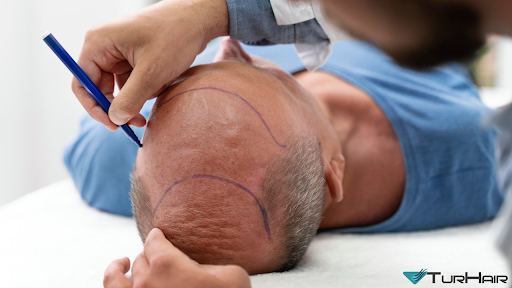
- Hairline design, drawn on the patient before any incision
- Preparation and numbing of the donor area
- Graft extraction, follicle by follicle
- Channel opening, which fixes angle, direction and depth
- Graft placement, then dressing and aftercare instructions
Follicular Unit Extraction (FUE), Sapphire FUE and Direct Hair Implantation (DHI) all follow this order, and DHI merges the last two stages. What varies between clinics is which stages a doctor performs in person.
Who Opens the Channels and Why it Shapes Most of the Result
Channel opening determines roughly 70 to 80 percent of the result, so at TURHAIR it stays with Dr. Demir and is never delegated.
Each channel is a micro incision that fixes three things at once. The angle decides how flat or upright the hair sits. The direction decides which way it falls and whether it follows the surrounding whorl. The depth decides how the graft seats in the skin.
Thousands of channels are made across a curved surface, and the correct angle shifts steadily from the frontal hairline back toward the crown.
This is what a doctor led hair transplant turkey model means in practice.
A channel cut at the wrong angle cannot be rescued by careful placement. The graft grows in the direction the channel gave it.
Is Hairline Design a Medical or an Aesthetic Decision?
It is both, which is why it belongs to the surgeon rather than to a template. Several variables are weighed at the same time:
- Facial proportions, and the shape of the forehead and temples
- Age now, and the likely pattern of loss in 10 to 20 years
- Donor capacity, which limits how much density can be placed
- Hair caliber, curl and color contrast against the scalp
- A soft, irregular transition zone instead of a straight line
Dr. Demir, a member of the International Society of Hair Restoration Surgery (ISHRS), draws the hairline on the patient and agrees it face to face. A line set too low can look convincing at 30 and unnatural at 45. Results vary by patient.
How Donor Area Planning Guards Against Overharvesting
Donor planning sets a budget for a patient’s whole life, not for one session. Hair taken from the donor area does not regrow there. Conservative planning at TURHAIR follows four principles:
- Extraction is spread across the safe donor zone, not concentrated in one patch
- Graft numbers stay inside the assessed capacity, typically 1,500 to 2,500 for mild loss and 2,500 to 3,500 for moderate loss
- Grafts are kept in reserve for a possible second session
- Cases needing 3,500 to 5,000 or more grafts are planned before any session is agreed
Extraction and Graft Handling on the Day
Extraction and placement are carried out by a trained team under Dr. Demir’s direct supervision. Grafts are fragile once they leave the scalp, so the team works in short, controlled batches.
Doctor Led and Technician Driven Work Compared Stage by Stage
The table below sets the two models side by side, stage by stage.
| Stage | Doctor Led Handling | Technician Driven Handling |
|---|---|---|
| Hairline design | Drawn by the surgeon, adjusted face to face | Applied from a standard template |
| Channel opening | Surgeon sets angle, direction and depth | Delegated, sometimes with limited supervision |
| Donor planning | Capacity assessed first, extraction spread out | Graft target driven by the package sold |
| Extraction and placement | Trained team under continuous supervision | Doctor present only briefly, if at all |
| Daily patient load | 1 to 2 patients per day at TURHAIR | Several parallel cases, less time for each |
Why Does a Limit of 1 to 2 Patients a Day Matter?
A low daily volume lets one surgeon attend the decisive stages of every case. Channel opening across a full recipient area takes hours of continuous concentration. The limit protects four things:
- An unhurried consultation, where the plan can change after examination
- A hairline drawn, reviewed and redrawn before the first incision
- Channel opening completed in one session by the same hand
- Aftercare instructions given directly to the patient
Only an individual assessment with the surgeon can show what a specific donor area supports.
Frequently Asked Questions
Which Parts of the Operation Does Dr. Demir Perform Personally?
At TURHAIR, Dr. Demir personally carries out the consultation, the diagnosis, the hairline design and the channel opening. He also plans the donor area and supervises the remaining surgical stages. Extraction and placement are handled by a trained team working under his direction. The split of tasks is explained during the consultation.
Does Channel Opening Happen Before or After the Grafts are Extracted?
In standard Follicular Unit Extraction (FUE), the grafts are removed first and the channels are opened afterwards, before placement begins. In Direct Hair Implantation (DHI), the implanter pen creates the site and delivers the graft in a single movement. Either way, the angle, direction and depth of every channel are set at that moment.
Can a Technician Design the Hairline Instead of a Doctor?
In some clinics a technician does draw it, usually from a template. A hairline is a medical judgment as well as an aesthetic one, because it must account for donor capacity and for future hair loss. At TURHAIR the design is made by Dr. Demir and agreed with the patient before surgery starts.
How Does a Daily Patient Limit Change the Way an Operation Runs?
Treating only 1 to 2 patients a day gives the surgeon continuous time in one operating room. Channel opening across a full recipient area takes hours of uninterrupted work. With a higher daily load, that stage is usually delegated. TURHAIR keeps the limit so the same hand completes the stage.