
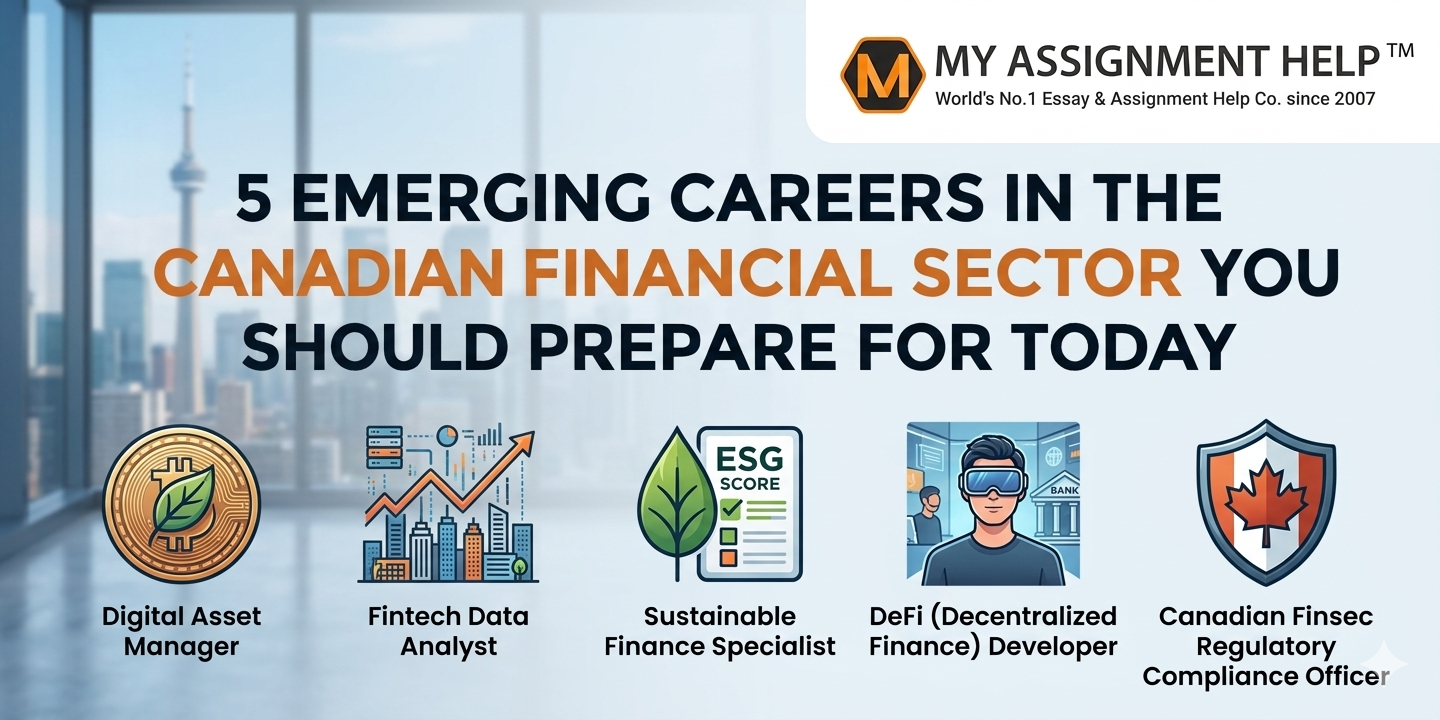
The Future of Finance: 5 Emerging Careers in the Canadian Financial Sector You Should Prepare for Today
The Canadian financial landscape is undergoing a seismic shift. Driven by rapid technological integration, a national pivot toward sustainability, and evolving regulatory frameworks, the sector is no longer defined solely by traditional banking and investment roles. For students and young professionals, this evolution represents a goldmine of opportunity—provided they possess the right mix of technical prowess and strategic foresight.
As Bay Street integrates everything from decentralized finance (DeFi) to climate risk modeling, the demand for specialized talent is outstripping supply. To stay competitive in this high-stakes environment, understanding where the market is heading is crucial. Whether you are currently pursuing a degree or looking to pivot your career, preparing for these emerging roles is the key to long-term professional stability.
Navigating the complexities of modern financial theories can be daunting for many students. If you find yourself struggling with the technicalities of market analysis or FinTech ecosystems, seeking professional finance assignment help can provide the academic foundation needed to excel in these competitive fields. Establishing a strong grasp of the fundamentals now ensures you are ready for the sophisticated demands of the future Canadian workforce.
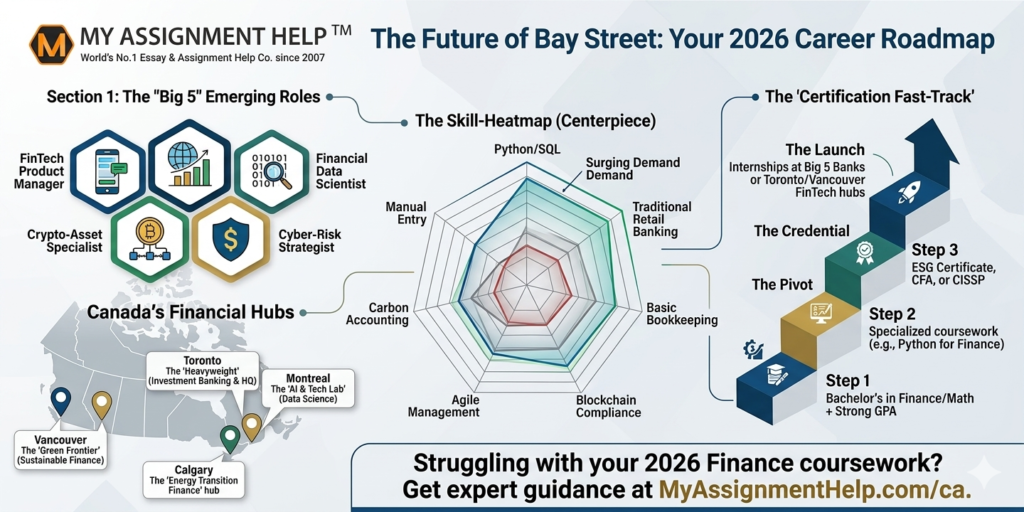
1. Sustainable Finance & ESG Analyst
Canada’s commitment to achieving net-zero emissions by 2050 has transformed Environmental, Social, and Governance (ESG) criteria from a “nice-to-have” into a core financial mandate. Major institutions like RBC, TD, and Scotiabank are aggressively hiring analysts to evaluate the climate risk of their portfolios.
- The Role: ESG Analysts assess how a company’s environmental footprint and social policies impact its long-term financial performance.
- The Data: According to the Responsible Investment Association (RIA), assets under management in Canada using at least one responsible investment strategy grew to $3.2 trillion in recent years.
- Preparation: Focus on obtaining certifications like the CFA Institute’s Certificate in ESG Investing.
2. Financial Data Scientist
The “Big Five” banks are sitting on mountains of data. The challenge is no longer collecting it, but interpreting it to predict consumer behavior and mitigate risk. Financial Data Scientists are the bridge between raw code and executive decision-making.
- The Role: Using Python, R, and Machine Learning algorithms to detect fraudulent transactions in real-time or to develop personalized banking experiences.
- The Data: A report by ICTC Canada suggests that the demand for data professionals in the financial sector will grow by nearly 15% by 2026.
- Preparation: Master data visualization tools like Tableau and gain proficiency in SQL and predictive modeling.
3. Cyber-Risk Financial Strategist
As Canada moves toward “Open Banking” (consumer-directed finance), the vulnerability to cyber-attacks increases. Financial institutions are looking for professionals who understand both the balance sheet and the firewall.
- The Role: These experts quantify the potential financial loss of data breaches and develop insurance and capital reserve strategies to protect the institution.
- The Data: The Bank of Canada’s Financial System Survey consistently identifies cyber incidents as the top risk to the Canadian financial system.
- Preparation: Combine a background in finance with cybersecurity certifications such as CISSP or CISM.
4. Crypto-Asset & Digital Currency Specialist
With the Bank of Canada exploring a Central Bank Digital Currency (CBDC) and the popularity of ETFs holding digital assets, the “crypto” space is maturing. We are moving past speculation into institutional integration.
- The Role: Managing digital asset portfolios, ensuring regulatory compliance with FINTRAC, and integrating blockchain technology into clearing and settlement processes.
- Preparation: Understand the mechanics of smart contracts and the regulatory landscape of the Investment Industry Regulatory Organization of Canada (IIROC).
5. FinTech Product Manager
The explosion of FinTech startups in hubs like Toronto, Vancouver, and Montreal has created a need for leaders who can manage the lifecycle of a financial product—from a mobile payment app to an automated lending platform.
- The Role: Product managers coordinate between software developers, legal teams, and marketing to ensure financial tools are user-friendly and compliant with Canadian consumer protection laws.
- Preparation: Pursue an MBA or a specialized Master’s in Financial Innovation.
For those currently buried under a mountain of coursework while trying to master these new domains, it is common to feel overwhelmed. Many students often decide to do my assignment through reputable academic services to free up time for practical skill-building and networking within these emerging sectors.
Key Takeaways
- Technical Literacy is Mandatory: Whether it’s ESG reporting or Data Science, the future of finance is digital and data-driven.
- Specialization Wins: General banking roles are shrinking; specialized roles in risk, sustainability, and tech are expanding.
- Regulatory Knowledge: Understanding Canadian-specific bodies like OSFI and FINTRAC is a major competitive advantage.
- Continuous Learning: The shelf-life of financial knowledge is shortening; certifications (CFA, ESG, FRM) are more vital than ever.
Comparison of Emerging Career Paths in Canada
| Career Path | Core Skill Required | Estimated Growth (5-Year) | Key Industry Driver |
| ESG Analyst | Carbon Accounting | High | Net-Zero Legislation |
| Data Scientist | Python/Machine Learning | Very High | Personalization & AI |
| Cyber-Risk Strategist | Risk Quantification | High | Open Banking Risks |
| FinTech PM | Agile Methodology | Moderate/High | Digital Transformation |
| Crypto Specialist | Blockchain/Compliance | Emerging | Digital Asset ETFs |
FAQ Section
Q: Do I need a CPA or CFA for these roles?
A: While a CFA is still highly respected, many emerging roles value specialized certifications (like the SCR for climate risk) or technical degrees (Computer Science) just as highly as traditional accounting designations.
Q: Which Canadian city has the most opportunities?
A: Toronto remains the primary hub (the 2nd largest financial center in North America), but Montreal is a leader in AI/FinTech, and Vancouver is seeing significant growth in sustainable finance.
Q: Is AI going to replace these financial jobs?
A: AI is a tool that will automate entry-level data entry. However, the roles mentioned above—like ESG Analysis and Cyber-Risk—require human judgment and strategic oversight that AI cannot yet replicate.
References
- Responsible Investment Association (RIA) – 2023 Canadian RI Trends Report.
- Information and Communications Technology Council (ICTC) – Canada’s Growth Prospects.
- Bank of Canada – Financial System Review (2024-2025).
- Financial Transactions and Reports Analysis Centre of Canada (FINTRAC) – Emerging Trends.
Author Bio:
Sarah Jenkins is a Senior Academic Consultant at MyAssignmentHelp, specializing in Canadian Financial Markets and Macroeconomics. With over a decade of experience in content strategy and financial tutoring, Sarah helps students navigate the intersection of traditional finance and emerging technology. She is a frequent contributor to educational blogs focusing on career readiness in the North American sector.